
Despite regional growth, nearly 40% of residents in Northeast Florida still struggle to make ends meet
June 10, 2026
 New ALICE data shows rising costs of basic needs are outpacing wage increases
Jacksonville, Fla. (June 10, 2026) – Despite regional economic growth post-COVID, nearly 40% of Northeast Florida residents still struggle to make ends meet, according to new data from the State of ALICE Florida report released today. The rising cost of household necessities is outpacing wage increases, leaving many households in Northeast Florida vulnerable to the growing affordability crisis.
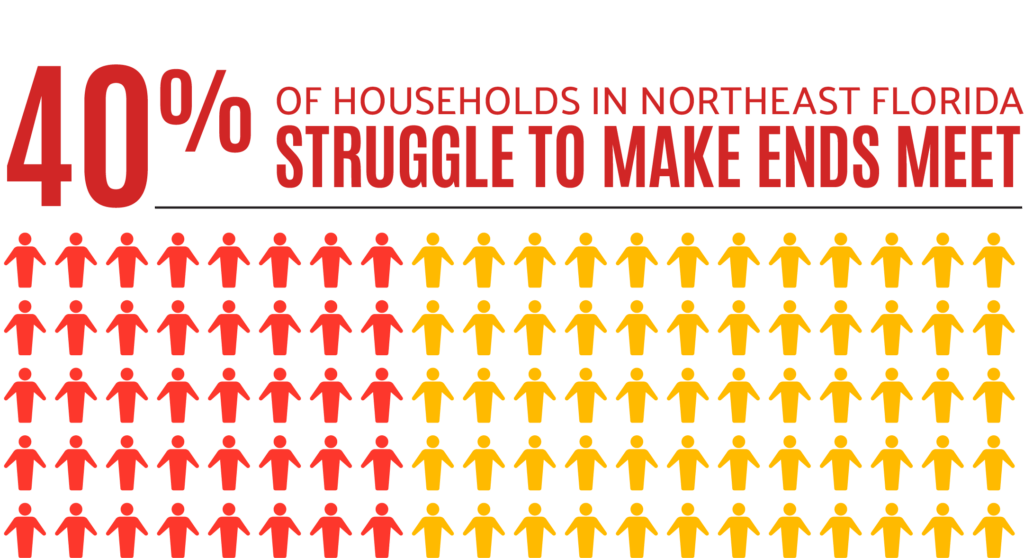
The report, released annually, highlights the stark reality that more than 281,000 households live paycheck-to-paycheck and experience financial insecurity in Northeast Florida. This population
includes 77,328 households living in poverty and 203,706 households known as ALICE® (Asset Limited, Income Constrained, Employed). ALICE families specifically earn income above the Federal Poverty Level but are unable to afford basic expenses. The report compiles U.S. Census data from 2024. Northeast Florida is defined as Baker, Clay, Duval, Nassau and St. Johns counties.
“When families can no longer afford to live in the communities they help build, we all feel the effects,” said Darnell Smith, chair of the board of directors for United Way of Northeast Florida. “The status quo is not sustainable. We must bring together funders, government, businesses and nonprofits to move beyond conversation and invest in solutions that create lasting economic stability for working families. It’s collective efforts that truly amplify philanthropy and fuel impact.”
Compared to last year’s report, the number of households in poverty decreased by 6,700. However, ALICE households increased by 13,456, indicating more families are being pushed into financial
hardship despite not meeting the federal definition of poverty. This shift suggests that affordability challenges are intensifying for working households, placing a growing number of families one
unexpected expense away from crisis.
The latest State of ALICE report for Florida includes data from the ALICE Essentials Index, which tracks the rising costs of six essentials families need to live and work: housing, child care, food,
transportation, health care and technology. Between 2007 and 2024, the ALICE Essentials Index for Florida increased 72%, compared with 52% for the broader Consumer Price Index (CPI), which reports inflation across more than 200 categories of goods and services.
“Affordability challenges are intensifying for working households, placing a growing number of families one unexpected expense away from crisis,” said James Ellout, vice president of community
impact at United Way. “Behind these numbers are families making impossible choices every day — between groceries and utilities, child care and rent. The ALICE data helps guide our work with
partners across Northeast Florida so we can respond to immediate needs and help build stronger long-term paths to stability.”
The struggle for ALICE families is revealed in the gap between wages and expenses. In 2024, a family of four in Northeast Florida needed $81,516 just to cover the essentials — more than 2.5 times the Federal Poverty Level of $31,200. This ALICE Survival Budget does not include emergency savings for urgent needs nor does it include savings for long-term goals, such as education or buying a home. To achieve savings goals, the ALICE report estimates the annual income of a family of four in Northeast Florida would need to be upwards of $125,000.
“The ALICE research shows that the affordability crisis is not new,” said Stephanie Hoopes, Ph.D., national director at United For ALICE. “Already stretched thin, ALICE families have no cushion for rising gas or utility costs — forcing tough tradeoffs with other necessities. That’s the insight policymakers and community leaders need to build a stronger future for ALICE and all.”
The State of ALICE in Florida also reveals in Northeast Florida:
- For a family of four (two adults with two children in child care), the largest monthly expenses are housing ($1,720), child care ($1,525) and food ($1,418), which is nearly 60% of their monthly budget ($7,874).
- Nearly 49% of senior households fall below the ALICE threshold; that means nearly half of seniors struggle to make ends meet every day.
- The largest percentage of households living with financial instability are young adults, with 66% of households under age 24 facing financial insecurity.
In October, United Way announced its new strategic plan, which outlines goals the organization plans to accomplish by 2030 in three new impact areas: healthy community, youth opportunity and financial security. United Way’s new strategic plan is grounded in the organization’s ALICE Promise, a commitment to develop and invest in community-driven solutions that address root causes of financial instability for all families living below the ALICE threshold. Through the strategic plan, United Way will increase upward mobility, access to essential services and community well-being for all. More information on this strategy can be found at unitedwaynefl.org/our-work.
“This strategy is about creating a community where everyone has a fair opportunity to thrive,” said Melanie Patz, president and CEO of United Way. “By focusing on upward mobility, expanding access to essential services and strengthening overall community well-being, we’re building pathways that help individuals and families achieve greater stability and reach their full potential.”
For questions regarding ALICE in Northeast Florida or interviews with United Way leadership, please email Sarah Henderson Daugherty, vice president of marketing and communications, at sarahd@nulluwnefl.org. To view local and state data, visit unitedwaynefl.org/alice.
For families seeking information on and referrals to community resources, please contact United Way 211 by dialing 2-1-1 or texting “hello” to 211904. This free helpline is available 24/7/365 and connects thousands of callers every month to available resources.
To help support families living below the ALICE threshold, donations of any size are welcome at unitedwaynefl.org/give or by emailing Éres McKee, vice president of philanthropy, at eresm@nulluwnefl.org. United Way also offers an interactive, educational “Meet ALICE Experience” to help raise awareness of the ALICE population. To learn more about this experience, email volunteer@nulluwnefl.org.
###
Related Posts

10 Signs You’d Make a Great ReadingPal

RealSense Volunteer Snapshot